
Discovering Hand Casting – The Day Everything Changed
You’re sitting across from your former husband in 2003, watching him work on something he calls hand casting. He’s trying to explain it to you, but the words aren’t clicking. Your mind doesn’t work that way. You need to see things, touch them, experience them before they make any sense. Abstract explanations just float right past you.
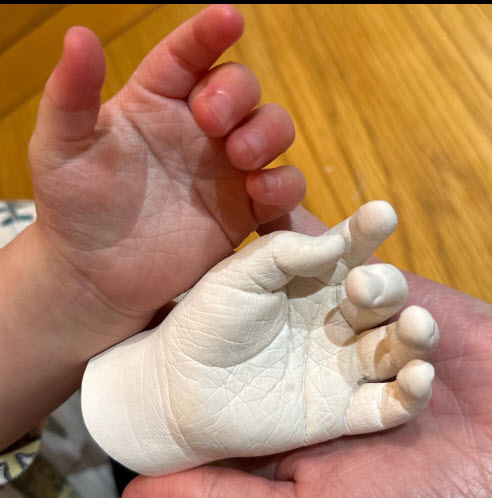
Then he shows you the finished piece. It’s a cast of his daughter’s tiny hands, frozen in white plaster. You watch his whole body change. His face softens. His shoulders drop. It’s like he’s flipping through an old photo album in his mind, reliving memories you can’t see. In that moment, you realize this isn’t just a craft project or a decoration. This is a time machine.
Seeing What You Couldn’t Before
You lean closer and study the cast. Every single ridge of her fingerprints is there. Every curve of her small fingers is suspended perfectly in the plaster. It’s not just capturing the shape of her hands, it’s capturing a moment between father and daughter, a snapshot of their relationship that he can hold in his palm.
You remember reading somewhere that sculptors have been using body casts for centuries. They made study models and death masks, trying to understand human anatomy. But back in the 1800s, some artists got accused of cheating if they used casts instead of modeling everything from scratch in clay. There was this whole debate about art versus authenticity, about what counted as “real” creativity.
But watching your husband hold that cast, you understand something those critics missed. If an exact replica of a hand can make someone feel something this deep, what else is possible?
Questions That Won’t Leave You Alone
At the time I wasn’t an artist, a historian or a sports fan. I didn’t play sports and I couldn’t tell you the difference between a home run and a touchdown. But emotion is universal. I know what it means to hold pride, effort and fleeting moments. When I saw that cast, I wondered whether the same technique could preserve a sports achievement or an everyday milestone. Could an athlete relive the feel of a game-winning catch by holding a cast of their own hand? Could a parent feel the weight of their newborn’s fist long after the baby is grown? Those questions stayed with me for years.
That curiosity led me to research the traditions behind casting. Artists have long made casts of limbs and torsos for anatomical study models. Some even created death masks of notable figures. The practice wasn’t just decorative , it was a form of keeping history tangible. When hand casting re-emerged as a hobby in modern times, it became more than an art form. It became a way for families to freeze moments, for athletes to celebrate milestones and for trauma survivors like me to reclaim time.
Diving Into History
Your curiosity pushes you to research. You discover that artists have been making casts of limbs and torsos for a long time, studying anatomy and creating reference models. Some even made death masks of famous people. The practice wasn’t just about decoration. It was about keeping history real and touchable.
When hand casting came back as a modern hobby, it became something more than art. You see families using it to freeze moments in time. Athletes use it to celebrate their biggest achievements. And for trauma survivors like you, it becomes a way to reclaim pieces of your own timeline that were stolen from you.
The Process: Simple but Magical
On the surface, hand casting looks easy. You dip a hand into molding material, wait for it to set, then fill the mold with plaster. But when you actually try it, you realize it’s an act of careful attention. Every detail matters.
The materials have to be safe for skin and mixed just right. The person has to stay completely still while the mold captures every crease and line. When you pour the casting material in, you’re not just filling empty space. You’re creating a solid memory, something you can actually hold.
Your brain responds differently to physical objects than to photographs. Scientists have proven this. When you hold something tangible, it activates your senses in a way that looking at a picture never can. It grounds your memories in the present moment.
When you first saw that cast of your stepdaughter’s hands, you weren’t just looking at it. You were feeling something shift inside you. That sensation became the seed for everything that came after. It led to Keepsakes of Triumph and your whole mission.
Why This Matters More Than You’d Think
Sports fans might assume that only championship rings and trophies can bring back memories. But you’ve learned that an exact hand cast tells a different kind of story. It captures the position of fingers in a game-winning shot. The tension in a rock climber’s grasp. The gentle curve of a parent’s hand cradling their newborn.
These casts aren’t just replicas. They’re emotional anchors that trigger whole narratives in your mind.
For athletes and families, this process offers something a photo or video can’t match. It’s three-dimensional. It’s tactile. When you hold a cast of your own hand from a pivotal moment in your life, your body remembers how it felt. That muscle memory has serious power over your mind and emotions.
Your Journey: From Survivor to Creator
You didn’t set out to build a business. As a survivor of human trafficking, you spent years feeling disconnected from your own timeline. Trauma messes with your sense of self and your perception of time in ways that are hard to explain to people who haven’t experienced it.
Human trafficking is a violation of human rights that leaves survivors dealing with depression, anxiety, and complex trauma. Psychologists talk about the importance of trauma-informed care and teaching communities to recognize the signs of exploitation. But for you, learning about hand casting became part of your own healing.
Creating and holding these casts helped you reclaim your body’s narrative. They helped you take back ownership of your own story.
The whole journey of Keepsakes of Triumph is about resilience. You went from someone who couldn’t tell a football from a baseball to someone who helps athletes capture their defining plays in three-dimensional form. You went from silence to telling your story publicly. And you learned that preserving moments isn’t just about nostalgia. It can actually be a tool for recovery and empowerment.
Where Art Meets Healing
Hand casting sits right at the intersection of art, memory, and emotional health. Sculptors used to make body casts to study anatomy and create realistic sculptures. Now, everyday people use the same technique to freeze meaningful moments in time.
Whether it’s the innocence of a child’s hand, the intensity of an athlete’s grip, or the connection between two people holding hands, each cast becomes an artifact of human connection.
There are real reasons why preserving memories this way matters:
Sensory grounding: When you hold a cast, you engage your sense of touch, your vision, and your spatial awareness. It grounds you in the present while letting you recall the past.
Personal agency: Choosing to capture a moment is an act of control. For survivors of trauma, having that choice can be incredibly healing.
Intergenerational connection: A cast passed down through generations carries stories that might otherwise disappear completely.
Researchers have noted that life casting has become an accepted practice among contemporary artists. Mental health experts recognize that trauma disrupts both memory and identity. When you put these ideas together, hand casting makes sense as both creative expression and therapeutic tool.
Answering the Doubts
Some people might argue that hand casting is just a novelty item. Others might say that digital photographs do the same thing. But here’s what you’ve learned: photographs capture a moment visually. They don’t engage your sense of touch or your spatial awareness. You can’t hold a photograph the same way you hold a three-dimensional cast.
Other people worry that focusing on the past prevents healing. But in your experience, honoring a moment actually helps you integrate it into your life story. It doesn’t freeze you in that moment. It lets you acknowledge what happened and carry it forward with intention.
What You Can Do Next
If this story connects with you, there are ways to explore further. You can learn about the process and see examples. You can check out sports hand casting options if you’re an athlete looking to commemorate a milestone. You can connect with a community of survivors and allies through resources that share articles and support services. Or you can reach out to create your own hand casting or host a workshop.
For readers interested in the historical context, the Smithsonian American Art Museum has written about body casts in 19th-century sculpture. To understand the psychological impact of trafficking, the American Psychological Association offers insights into treating survivors with trauma-informed care.
These resources provide broader perspectives and help explain why this mission extends beyond art. By combining creative practice with empathy and education, the goal is to honor your stories and help you seize your own moments.
Moving Forward
Seizing a moment isn’t about getting stuck in the past. It’s about acknowledging what shaped you and carrying it forward into your future. Whether you’re commemorating an athletic achievement, preserving your child’s tiny fingers, or reclaiming your history as a survivor, hand casting offers a way to literally hold time in your hands.
It reminds you that your story is worth preserving. It reminds you that your story is worth sharing.
Your moments matter. Your memories deserve to be held onto. And sometimes, the best way to move forward is to create something you can carry with you. Something real, something tangible, something that proves you were here and that what you experienced was real.
Join the Keepsakes of Triumph Journey
If this story resonates with you, there are several ways to explore further:
- Learn about the process and see examples on our How It Works page.
- Explore our Sports Hand Casting options if you’re an athlete looking to commemorate a milestone.
- Connect with our community of survivors and allies on the Resources page, where we share articles and support services.
- Reach out via Contact if you want to create your own hand casting or host a workshop.
By linking different parts of our site together, we invite you to move from one story to the next. Each page offers its own insight into how hand casting can transform experiences and create lasting connections.
External Resources
For readers interested in the historical and ethical context of body casting, the Smithsonian American Art Museum’s article on Hiram Powers’ Greek Slave discusses the use of body casts in 19th‑century sculpture. To understand the psychological impact of trafficking and the importance of trauma‑informed care, the American Psychological Association’s piece on treating survivors of human trafficking provides key insights.
These external resources offer broader perspectives and underscore why our mission at Keepsakes of Triumph extends beyond art. By combining creative practice with empathy and education, we hope to honour your stories and help you seize your moments.
Closing Thoughts
Seizing a moment isn’t about dwelling in the past; it’s about acknowledging what shaped you and carrying it forward. Whether you are commemorating an athletic achievement, preserving your child’s tiny fingers or reclaiming your history as a survivor, hand casting offers a way to hold time in your hands. It reminds us that our stories are worth preserving and sharing.
Join us at Keepsakes of Triumph to capture your own stories and discover the power of holding on to what matters.